Tuberculosis (TB): A Complete Overview
TB killed 1.23 million people globally in 2024 — and U.S. cases are rising for the fourth consecutive year, reaching 10,347 in 2024. Here’s what everyone should know about active vs. latent TB, drug-resistant TB, diagnosis, and treatment.
Tuberculosis is the world’s oldest and most persistent infectious disease killer — and it is both preventable and curable. Despite remarkable progress over decades, TB remains a leading cause of global death, a major driver of antimicrobial resistance, and, increasingly, a resurgent threat in the United States.
Key Statistics
- 10.7 million people fell ill with TB worldwide in 2024
- 1.23 million deaths from TB globally in 2024 — the world’s #1 single infectious killer
- 10,347 U.S. TB cases in 2024 — highest in over 12 years
- ~25% of the global population estimated to have latent TB infection
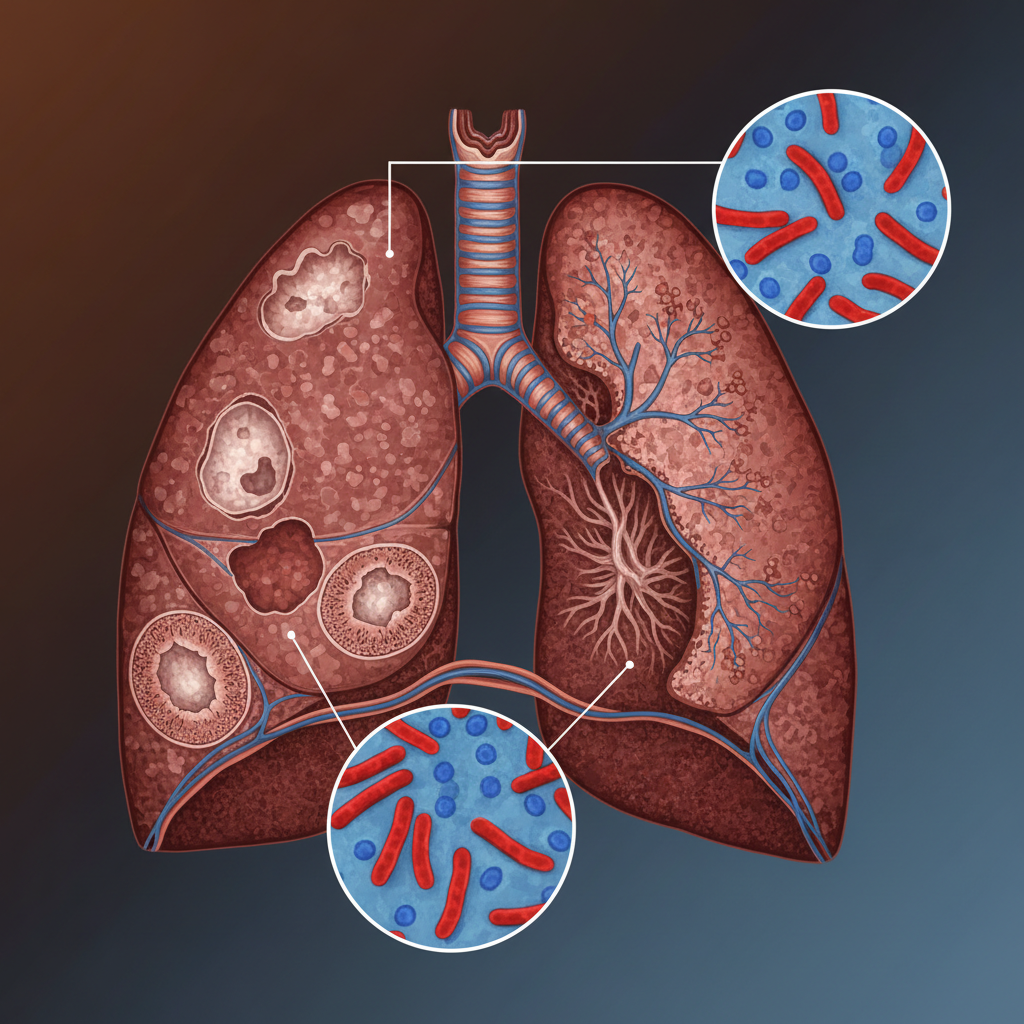
What Is Tuberculosis? Tuberculosis is a bacterial infection caused by Mycobacterium tuberculosis. It is spread through the air when a person with active pulmonary TB coughs, speaks, sneezes, or sings — releasing tiny infectious droplets that can be inhaled by people nearby. TB primarily affects the lungs (pulmonary TB), but can spread through the bloodstream to virtually any organ: the brain, spine, kidneys, bones, and lymph nodes (extrapulmonary TB).
Unlike many bacterial infections, TB is not easily transmitted through casual contact — it typically requires prolonged, close exposure to an infectious person, especially in enclosed, poorly ventilated spaces.
How M. tuberculosis Evades the Immune System: After inhalation, the bacteria are engulfed by alveolar macrophages — but rather than being destroyed, the bacteria survive and replicate inside them. The immune system walls them off in granulomas. In most people, the immune system keeps the infection dormant indefinitely (latent TB). If immunity is weakened — by HIV, malnutrition, immunosuppressive drugs, aging, or stress — the granulomas can break down and TB can reactivate into active, transmissible disease.
Latent TB vs. Active TB Disease
Latent TB Infection (LTBI) — Contained, No Symptoms, Not Contagious:
- No symptoms — person feels completely well
- Cannot spread TB to others
- Chest X-ray: normal (or old healed lesions)
- Sputum culture: negative
- ~25% of world population has LTBI
- 5–10% lifetime reactivation risk without treatment
- Preventive therapy reduces reactivation risk by up to 90%
Active TB Disease — Symptomatic, Contagious, Requires Immediate Treatment:
- Cough, fever, night sweats, weight loss
- Pulmonary TB is highly contagious
- Chest X-ray: abnormal — infiltrates, cavities
- Sputum culture: positive for M. tuberculosis
- 10,347 U.S. cases reported in 2024
- Fatal in ~45% of cases historically without treatment
- Requires mandatory multi-drug antibiotics for 6 months or longer
A person with one active pulmonary TB case can infect 10–15 other people per year if untreated. Preventive therapy for LTBI reduces reactivation risk by up to 90%.
Symptoms of Active TB Active pulmonary TB typically develops gradually over weeks to months. The “classic” triad is cough, night sweats, and weight loss:
- Persistent cough lasting 3 or more weeks — may produce blood-tinged sputum
- Night sweats — often drenching, requiring change of clothes or sheets
- Unintended weight loss and loss of appetite
- Fever — often low-grade and persistent
- Fatigue and generalized weakness
- Chest pain or discomfort (especially with breathing or coughing)
- Coughing up blood (hemoptysis) — in more advanced disease
- Shortness of breath — in extensive lung involvement or pleural effusion
Extrapulmonary TB accounts for about 20% of active TB cases in the U.S. Common extrapulmonary sites include lymph nodes (most common), pleura (causing pleural effusion), spine (Pott’s disease), meninges (TB meningitis — a neurological emergency), kidneys, and genitourinary tract. Extrapulmonary TB often presents without respiratory symptoms, making diagnosis particularly challenging.
Who Is Most at Risk?
- Non-U.S.-Born Individuals: 76% of U.S. TB cases in 2023 occurred in people born outside the U.S. — primarily from India, Mexico, Philippines, Vietnam, and China.
- People Living with HIV: HIV is the single most powerful risk factor for TB reactivation — increasing the lifetime risk of active TB from 5–10% to 10–15% per year. TB was the leading killer of people with HIV in 2024.
- Immunosuppressed Individuals: Patients on TNF inhibitors, corticosteroids, cancer chemotherapy, or organ transplant immunosuppression. Mandatory LTBI screening before starting these medications.
- Congregate Settings: Prisons, homeless shelters, nursing homes, and overcrowded housing — close, prolonged contact in enclosed spaces creates high transmission risk.
- Substance Use & Poverty: Alcohol use disorder, substance use, malnutrition, and poverty impair immune response and are often associated with limited healthcare access.
- Older Adults & Diabetes: Age-related immune decline and diabetes-related immune impairment both increase reactivation risk. Poorly controlled diabetes triples the risk of active TB.
Diagnosis Diagnosing TB requires a combination of tools — no single test is definitive in all clinical scenarios.
- Interferon-Gamma Release Assays (IGRAs): Blood tests (QuantiFERON-TB Gold, T-SPOT.TB) that detect the immune response to M. tuberculosis proteins. Preferred over tuberculin skin test — not affected by BCG vaccination. Used primarily to diagnose latent TB infection.
- Tuberculin Skin Test (TST / Mantoux): PPD injected under the skin; read 48–72 hours later. False positives occur in BCG-vaccinated individuals. Still widely used where IGRAs are unavailable.
- Sputum AFB Smear & Culture: Acid-fast bacillus (AFB) smear for rapid initial result; mycobacterial culture (2–6 weeks) confirms M. tuberculosis and provides drug susceptibility testing (DST). DST is essential — identifying drug resistance guides therapy.
- Molecular Testing (GeneXpert MTB/RIF): WHO-endorsed rapid molecular test delivering simultaneous TB diagnosis and rifampicin resistance detection in under 2 hours. Transformative for TB diagnosis globally.
- Chest X-Ray & CT: CXR typically shows upper lobe infiltrates, cavities, or hilar lymphadenopathy. Normal CXR does not rule out extrapulmonary TB or early disease.
- Tissue / Biopsy: Essential for diagnosing extrapulmonary TB. Characteristic granulomatous inflammation on histology is strongly suggestive.
Treatment TB is curable — with the right drugs, for the right duration, taken consistently. Treatment interruption is the primary driver of drug resistance, relapse, and ongoing transmission.
- Latent TB (LTBI) — Preferred: 3HP (Isoniazid + Rifapentine weekly × 12 doses) for 3 months. Reduces reactivation risk by up to 90%.
- Latent TB (LTBI) — Alternative: 4R (Rifampin daily × 4 months) or 6H (Isoniazid daily × 6 months).
- Drug-Susceptible Active TB (Standard): RIPE regimen — Rifampin + Isoniazid + Pyrazinamide + Ethambutol for 2 months, then Rifampin + Isoniazid for 4 months. Total: 6 months. Directly observed therapy (DOT) is recommended.
- TB Meningitis / Bone TB: Same RIPE regimen, extended to 9–12 months. Dexamethasone added for TB meningitis.
- MDR-TB: BPaL/BPaLM regimen (Bedaquiline + Pretomanid + Linezolid) for 6–9 months. Major advance: 89% treatment success rate. Dramatically shortened from prior 18–24 month regimens.
- XDR-TB: BPaL regimen showed 90% treatment success in the ZeNix trial — a transformative result for previously near-untreatable disease.
The Drug-Resistant TB Crisis Multidrug-resistant TB represents one of the most dangerous antimicrobial resistance threats in the world. Only about 2 in 5 people with drug-resistant TB worldwide are receiving treatment.
- ~400,000 new MDR/RR-TB cases globally in 2024
- ~42% of estimated MDR-TB patients accessed treatment in 2024
- BPaL/M: New 6-month regimen showing ~89–90% success, replacing 18–24 month regimens
Stopping TB antibiotics early — even when symptoms resolve — allows surviving bacteria to develop drug resistance. DOT (directly observed therapy) is the standard of care precisely because TB is one of the few infections where treatment completion is a public health imperative.
The U.S. Resurgence: What’s Happening After 27 years of consistent decline, U.S. TB cases have risen for four consecutive years — reaching 10,347 in 2024 (up 8% from 2023, the highest in over 12 years). 76% of cases occurred in people born outside the United States. 34+ states reported increases, including a 150% surge in Kansas.
What’s driving the increase? Public health experts point to: COVID-19-era diagnostic disruptions that delayed both TB detection and latent TB treatment; increased population mobility and international migration from high-burden countries; reduced access to routine healthcare during and after the pandemic; and gaps in public health infrastructure and TB program capacity.
Prevention
- Treating latent TB infection — The single most powerful prevention strategy in the U.S. Screening with IGRA is recommended for all new immigrants from high-burden countries, immunocompromised patients, and close contacts of active TB cases.
- Infection control — Airborne precautions (N95 respirators, negative pressure rooms), proper ventilation, and isolation of infectious cases are essential in healthcare and congregate settings.
- BCG vaccine — Given to infants in high-burden countries; provides significant protection against severe childhood TB (including TB meningitis). Several new TB vaccines are in advanced clinical trials.
- Global equity — TB is fundamentally a disease of poverty, crowding, and healthcare access inequality. True TB elimination requires sustained global funding, which remains critically insufficient.
⚠️ Funding cuts threaten to reverse decades of progress. The WHO has warned that projected reductions in global health funding could result in over 2 million additional TB deaths over the next decade.
This content is for informational purposes only and does not constitute medical advice. Always consult a qualified healthcare provider.