
Louisiana's Abortion Pill Case Could Wipe Out Access in Blue States
Louisiana will argue before a federal appeals court that FDA rules allowing telehealth prescription and mail delivery of mifepristone infringe on its right to prohibit abortion — but if it succeeds, it would wipe out online and mail access in states where abortion is legal, cutting off millions from a method they increasingly depend on.
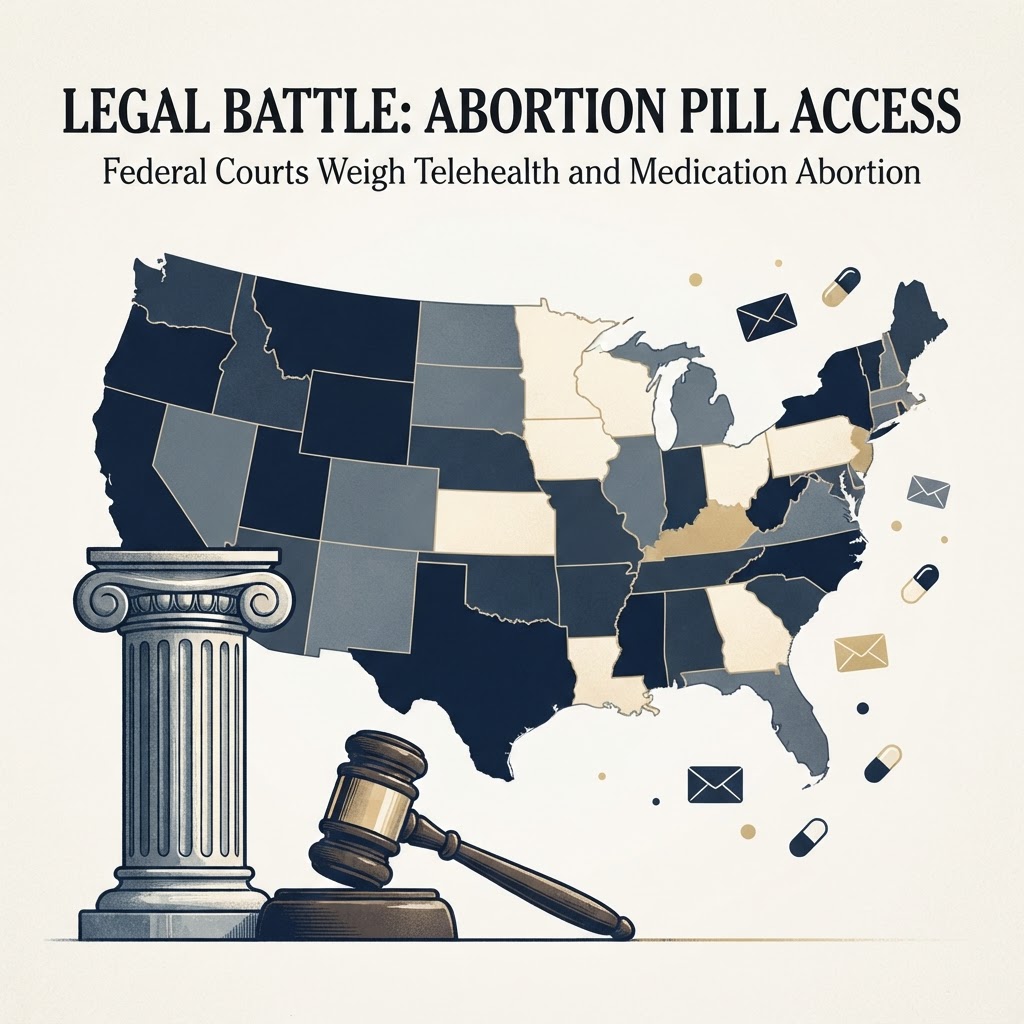
The next phase in the abortion wars may come down to one question: Do the rights of red states to enforce bans override the rights of blue states to protect access?
Louisiana will argue before a federal appeals court this week that FDA rules allowing telehealth prescription and mail delivery of the drug mifepristone infringe on the state's right to prohibit abortion within its borders. But should its lawsuit succeed — or one of the others like it filed by Florida, Idaho, Kansas, Missouri or Texas — it would wipe out online and mail access in states where abortion is legal, cutting off millions of residents from a method they increasingly depend on.
In defending their states' rights, abortion rights advocates and Democratic state leaders say, the GOP officials are trampling on those of others.
"They can have their ban," California Attorney General Rob Bonta said of Louisiana and the other states suing over federal telehealth abortion rules. "I don't like it. I think it's wrong. I think Roe v. Wade should be the rule, but it's not, and we accept that. But don't reach into our state and try to impose restrictions."
Bonta and the Democratic attorneys general of 21 other states and the District of Columbia submitted a friend-of-the-court brief arguing that Louisiana's lawsuit "improperly elevates the policy preferences of states that have banned or restricted abortion over the preferences of other States that have made the different but equally sovereign determinations to promote access to abortion care."
The case threatens to rip up the delicate national patchwork of abortion access that emerged after the fall of Roe v. Wade in 2022, with dozens of GOP-led states restricting or banning abortion and the rest enacting laws to preserve access to mail-order pills and in-clinic surgical procedures.
Many of the same conservatives who called for returning the issue to the states are now furious that the total number of abortions has increased, largely due to telehealth, and are pursuing federal restrictions through litigation, legislation and regulation.
The Case Before the 5th Circuit
Ahead of Wednesday's oral arguments before the 5th Circuit Court of Appeals in New Orleans, Louisiana argued that rules adopted under the Biden administration allowing doctors to prescribe and send abortion pills to patients without an in-person examination render its abortion ban "meaningless" because patients can have the drugs shipped across state lines into Louisiana.
The state contends that the undermining of its ban was "the target and object" of the telehealth rules, though they first began in 2021 — before the Supreme Court overturned Roe v. Wade — after Hawaiians who had to take a boat or plane from one island to another to access abortion pills sued the FDA.
"Louisiana has passed its own laws protecting life, and so [the telehealth rule] infringes directly on Louisiana's ability to do that," Gabriella McIntyre with the Alliance Defending Freedom, which is representing Louisiana in the case, said in an interview.
She confirmed that the lawsuit is seeking to eliminate online and mail access to abortion medication nationwide, including in states that favor it, noting that it would be logistically impossible to prevent delivery of the drugs to some parts of the country and not others.
Still, McIntyre insisted that even if courts abolish the telehealth option, blue states "can do what they want within their borders" and "will still be able to have their own regulations regarding abortion."
Democratic state officials disagree, writing in their court brief that Louisiana's lawsuit "runs roughshod" over the Supreme Court's 2022 ruling that gave states the power to set their own abortion policies. They warn that a ruling requiring everyone who currently gets abortion pills by mail to see a doctor in person would overwhelm their finite — and shrinking — number of clinics, driving up wait times for many forms of health care for both blue state residents and those traveling from states with bans. That, they added, could in turn cause higher rates of unintended pregnancy, more sexually-transmitted infections, and later detection of cancers due to people struggling to schedule screenings.
The case, Bonta said in an interview, is "not just about agency and state sovereignty."
"The health, safety, and welfare of Californians would be harmed by Louisiana's actions," he said. "We have residents in rural and medically underserved areas in the Eastern Sierras that are 200 miles from the nearest abortion provider. [Without telehealth] they're not going to be able to have the abortion care that they want and deserve and are legally entitled to."
Those who can make it to a clinic, he added, will take "staff time and resources away from other services they provide, like pre- and post-natal care, family planning, cancer screening, testing, and treatment for sexually transmitted diseases and HIV."
The Role of Telehealth
While telehealth abortions have increased most in states with bans over the last few years, online abortion pills also account for as much as 44 percent of all abortions in states that permit abortion. Even in the states where the share is closer to 10 percent, like New York and California, they account for tens of thousands of abortions each year.
"It's not the way the majority of folks are getting care in a lot of those states, but it plays a really big role," said Isaac Maddow-Zimet, a data scientist with the pro-abortion rights think tank Guttmacher Institute. "And often the people getting that kind of care might have difficulty getting it otherwise. They might be far from a clinic. That's particularly true in a place like California that has a lot of rural areas."
Other blue state patients, he added, prefer telehealth because they fear encountering protesters outside an abortion clinic, or are afraid of being ostracized by their community if they're spotted entering one.
"People choose telehealth [abortions] for many of the same reasons they use telehealth for other kinds of health care," said Melissa Grant, the co-founder and chief operations officer of Carafem, a network of clinics and online abortion pill providers that only operate in 21 states where abortion is legal, and do not mail the drugs into states with bans. "It's private, it's convenient, it's faster, and it has the ability for people to receive care without unnecessary travel."
Out of the roughly 30,000 patients Carafem saw last year, said Grant, 83 percent opted for telehealth. Those who didn't were either too far along in their pregnancies to use the drugs, had complicating medical conditions, or wanted stronger pain management — up to full sedation — that is not possible by remote prescription.
Telehealth abortions also cost hundreds of dollars less than obtaining the same medication from a clinic or hospital, and they eliminate the need for women to spend additional money on transportation, child care and other costs associated with travel to appointments.
Source: Alice Miranda Ollstein, POLITICO, September 9, 2026. This article is for informational purposes only and does not constitute medical or legal advice.