
The New Medicaid Map: Georgia and Texas Move Toward Expansion as Kentucky Fights to Protect Its Own
Newly elected Democratic governors in Georgia and Texas say expanding Medicaid is a top priority. Kentucky, which expanded in 2014, offers a preview of what comes after a state says yes — and of the new federal rules every expansion state now has to live with.
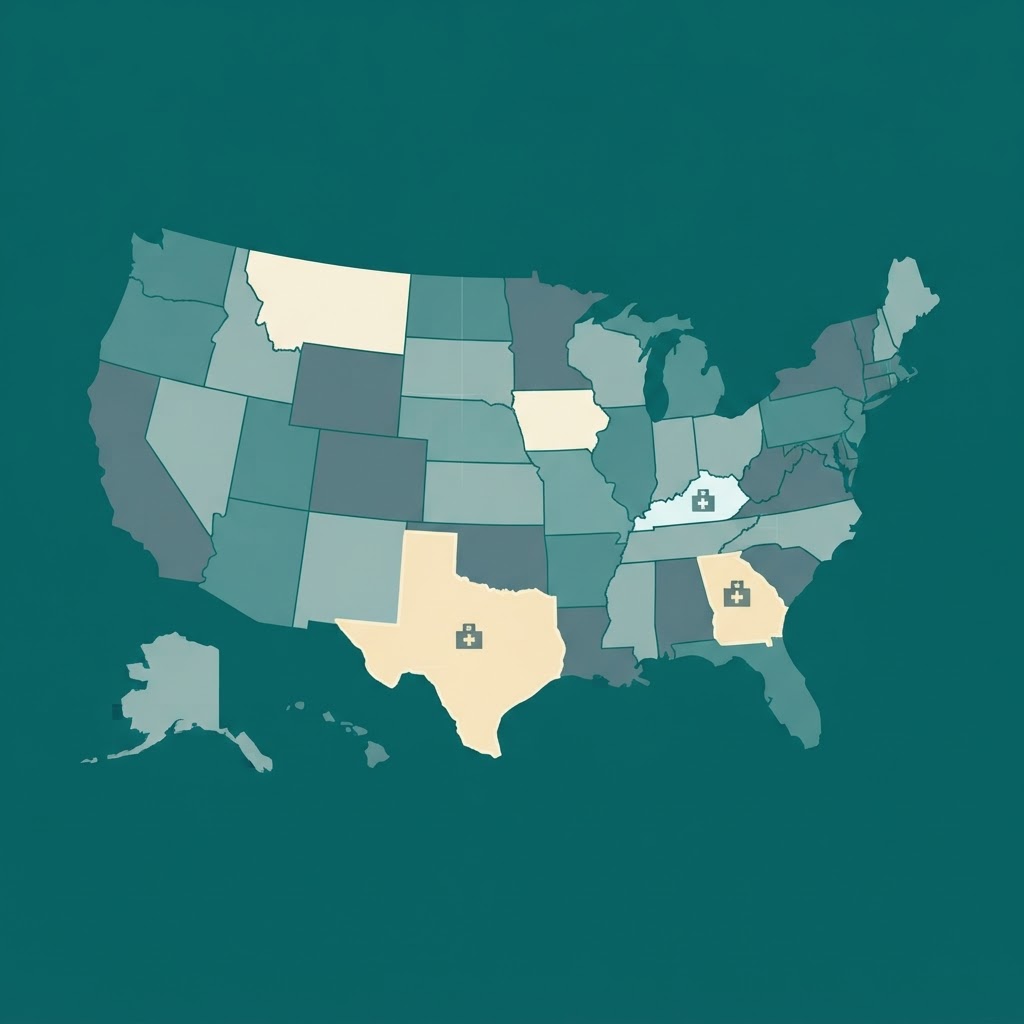
The 2026 midterms reopened one of the longest-running fights in American health policy. Newly elected Democratic governors in Georgia and Texas say expanding Medicaid is a top priority. Kentucky, which expanded more than a decade ago, offers a preview of what comes after a state says yes — and of the new federal rules every expansion state now has to live with.
Why this is back on the table
Under the Affordable Care Act, states can extend Medicaid to adults earning up to 138% of the federal poverty level, with the federal government paying 90% of the cost. Ten states still have not done so, and Georgia and Texas are two of the largest.
What changed is politics. On November 3, Democrats won the governor's races in both states and took control of each state's House of Representatives. Republicans kept control of both state Senates, so expansion still needs at least some Republican votes. Democrats also won both chambers of Congress, while Republicans still run the executive branch, including the Centers for Medicare & Medicaid Services (CMS).
The ground rules have changed too. The 2025 federal budget law, H.R. 1 (the “One Big, Beautiful Bill Act”), cuts nearly $1 trillion from Medicaid over the coming years and puts new conditions on expansion coverage:
New federal rules for expansion coverage
- Work requirements: Starting January 1, 2027, adults in expansion coverage must show 80 hours a month of work, school or community service, or qualify for an exemption.
- More paperwork: Eligibility checks every six months instead of once a year, and shorter retroactive coverage.
- Cost-sharing: New copays for some expansion enrollees beginning October 2028, capped at 5% of family income.
- Financing limits: Limits on some of the tools states use to pay their 10% share, plus a cut to a hospital funding stream that falls a bit harder on expansion states.
In other words, a state that expands in 2027 gets a different program than the states that expanded in 2014.
Georgia: from "Pathways" to full expansion?
Gov.-elect Keisha Lance Bottoms made full Medicaid expansion the center of her campaign and has called it "a day one priority." She launched her general-election push outside a closed rural hospital in Commerce.
What Georgia has now. Instead of full expansion, Gov. Brian Kemp created Georgia Pathways to Coverage in 2023. It covers adults earning up to 100% of the poverty level, but only if they report work or other qualifying activities. Enrollment has come in far below projections: about 20,000 people today, compared with more than 300,000 who could qualify under full expansion. Pathways' federal approval runs through December 31, 2026, and the program must change to meet the new federal work rules in January.
Who could gain coverage. The Center on Budget and Policy Priorities estimates about 347,000 uninsured Georgians could be eligible under full expansion, before counting anyone who loses coverage to work requirements. Hospital advocates say another 500,000 people now on ACA marketplace plans could move to Medicaid.
The money. The federal government pays roughly two-thirds of the cost of traditional Georgia Medicaid. For expansion adults, it would pay 90%.
The hurdles.
- The Senate. Republican senators are noncommittal so far. The state GOP says it wants coverage "on Georgia terms," built around work requirements and private plans, which leaves room for a negotiated, Arkansas-style compromise.
- Technology. The state's eligibility system is outdated and will need state money to fix. One process takes 45 to 60 clicks.
- Hospitals. The Georgia Hospital Association has not taken a position. Its members would gain newly insured patients, but would also see some federal hospital funding shrink and lower payments for patients who move from marketplace plans to Medicaid.
Ryan Loke, who helped design Pathways as Kemp's health policy adviser and now leads health policy at Grady Health System, predicts the 2027 General Assembly will expand Medicaid. He also warns that the federal changes make the result look very different from the expansion advocates have pictured for years.
Texas: the biggest prize, and the steepest climb
Texas has the highest uninsured rate in the country: about one in six residents, or roughly 5.2 million people. Expansion would cover more than 1.1 million Texans and could bring up to $10 billion a year in federal money into the state.
Gov.-elect Gina Hinojosa and Lt. Gov.-elect Vikki Goodwin have both made expansion a priority. Goodwin filed an expansion bill as a state representative, and as lieutenant governor she will preside over the Senate.
No shortcut. Texas law bars the state from changing Medicaid eligibility without the Legislature's approval, so an executive order alone is not expected to do it.
The bills. Democrats started filing bills right after the election. By November 12, at least 18 measures had been filed to expand Medicaid or build an alternative program with expansion funding. They include House Bills 101 and 102 from Rep. John Bucy III, and Senate bills from Sens. Judith Zaffirini, José Menéndez and Carol Alvarado. Lawmakers are weighing two main approaches:
- Pass expansion directly through the Legislature.
- Let voters decide with a constitutional amendment. One version would take effect January 1, 2028, only if voters approve.
Another idea is a "trigger" bill that would turn expansion on only if the new Democratic majority in Congress repeals some of the costliest federal rules.
Timeline. The 140-day legislative session opens January 12, 2027. Hinojosa and Goodwin take office January 19.
The hurdles. Republicans still hold the Senate, where expansion has died in past sessions. The state's eligibility system already has a serious backlog, and expansion would add more complex data checks on top of it.
Leo Cuello of Georgetown University's Center for Children and Families says the math still favors expansion, pointing to the uninsured rate, support for rural hospitals and less uncompensated care. He also cautions that Texas may not get to a final "yes" in 2027, but it is closer than it has ever been.
Kentucky: what's at stake for a state that already expanded
Kentucky isn't a holdout. It expanded Medicaid in 2014 and became one of the clearest examples of what expansion can do. Medicaid and CHIP enrollment has more than doubled since 2013, to about 1.3 million people, and roughly 450,000 to 465,000 of them are covered through expansion. Researchers have documented big increases in preventive care since then, including cancer screenings, diabetes screenings and HIV tests.
Kentucky's fight now is over keeping that coverage and changing how it works.
- New state rules. In April 2026, the Republican-led General Assembly overrode Gov. Andy Beshear's line-item vetoes of a budget bill with new paperwork requirements for expansion enrollees.
- Work requirements start January 1, 2027. About 70,000 expansion adults aged 19 to 64 are expected to be subject to the new community engagement rules. State law bars any delay. Expansion enrollees will also have to renew every six months.
- Coverage losses expected. State health secretary Dr. Steven Stack has said "tens of thousands" of Kentuckians could lose coverage for paperwork reasons.
- Efforts to lock in expansion stalled. Democratic lawmakers proposed constitutional amendments (House Bills 15 and 165, Senate Bill 93) to let voters protect expansion permanently. None got out of committee in the 2026 session.
For Georgia and Texas, Kentucky is both a selling point and a warning. It shows the coverage and health gains expansion can bring. It also shows that under today's federal rules, signing up eligible people and keeping them enrolled is now as big a job as passing the law.
What it means for providers and care organizations
- Hospitals, especially rural ones, in Georgia and Texas stand to gain fewer uninsured patients and less uncompensated care, but the financial math is more mixed under H.R. 1 than it was a decade ago.
- Enrollment and retention will be the bottleneck. With six-month renewals and monthly work reporting, patients will lose coverage over paperwork. Health systems, home care agencies, clinics and community groups that help patients document work hours and file renewals will play a bigger role.
- Care transitions get harder when coverage churns. Discharge planners and post-acute and home care teams should expect more patients whose coverage changes mid-episode, and should check eligibility early.
- Watch the calendar. Georgia and Texas lawmakers convene in January; the federal work rules start January 1, 2027; and Congress may take up a proposed two-year delay backed by Sen. Raphael Warnock.
The bottom line
After more than a decade of gridlock, Georgia and Texas have governors and House majorities who want to expand Medicaid. Both still need Republican votes in their Senates, and both would be expanding into a tougher federal framework. Kentucky shows the payoff, and the new risks, of being on the other side of that decision. For patients and providers in all three states, 2027 is shaping up to be a pivotal year.
Sources
- Democratic wins revive Medicaid expansion push in Georgia, but new hurdles await — Georgia Recorder, Nov. 12, 2026
- Georgia Democrats poised to push Medicaid expansion in 2027 — Atlanta Journal-Constitution
- Democratic wins put Medicaid expansion back in play in holdout states — States Newsroom, Nov. 6, 2026
- Georgia helped inspire the Medicaid work rules. Its own rules could soon end. — KFF Health News
- CMS approves temporary extension of Georgia Pathways — Manatt Health
- Texas Democrats want to expand Medicaid, but changes to federal landscape could complicate efforts — Texas Public Radio/KERA, Nov. 13, 2026
- Gov.-elect Hinojosa wants to expand Medicaid in Texas. An executive order won't make that happen. — Texas Tribune, Nov. 9, 2026
- Medicaid expansion returns to a changed Capitol — Texas Policy Research
- 'I don't know if we've seen the worst of what's coming.' Medicaid changes loom for Kentuckians — Kentucky Lantern, Nov. 11, 2026
- Kentucky Medicaid Advisory Council meeting minutes, April 2026 — Kentucky CHFS
- Kentucky legislature overrides governor's veto on Medicaid work requirements bill — Ballotpedia
- Kentucky Medicaid and Texas Medicaid — healthinsurance.org